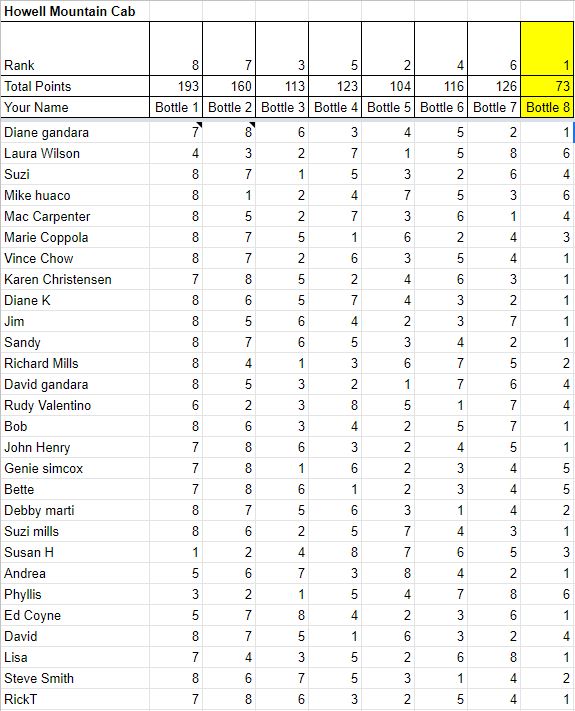
Another fine tasting was held at the home of our new members Vince & Karen in their spacious home in Danville, and once again a delicious Italian meal was catered by Locanda Ravello of Danville. As for the tasting of Howell Mountain Cabernet Sauvignons, unlike other tastings where the club #1 was someone’s #8 and vice versa, this time there was a clear favorite: the 2016 Cade Howell Mtn Estate Cab with 73 points (bottle #8). This wine was rated 96 points by Robert Parket and retails for $110/bottle. Our club rating was 31 points better than the 2nd place wine, bottle #5 the 2015 O’Shaughnessy Howell Mtn. Cab ($100). Our least favorite wine was also the oldest, bottle #1 the 1996 St. Clement Howell Mtn Cab ($50). It was generally acknowledged that this wine was past its prime.
Here’s the individual voting results of the 28 people who did the tasting.
For full details of the wines that were tasted, click HERE.
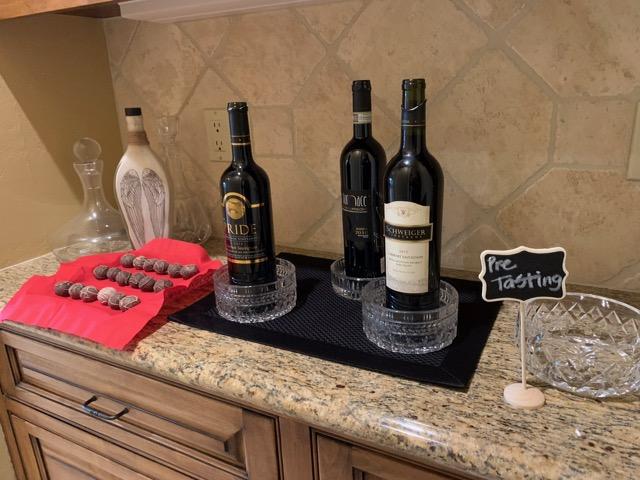
Pre-taste wines:
The hosts: Karen & Vince, Diane & Indra




Indra with new preferred guests Richard and Suzi Mills




ANNOUNCEMENT
WHAT: Howell Mtn Cabernet Sauvignon
WHERE: Danville
WHEN: Sat. Feb. 8 at 6 P.M.
HOSTS: Vince & Karen, Indra & Diane
Love, the eyes.
I raise the glass to my mouth,
I look at you,
I sigh.”
~ William Butler Yeats
Howell Mountain Napa Valley:
On the northeastern side of the Vaca Mountains, Howell Mountain became an appellation in 1983. It includes vineyard sites from 1,400 to 2,500 feet above sea level, surrounded by pine forest.
Among the first appellations to be formed following Napa Valley itself, Howell Mountain’s prime growing land benefits from a Howell Mountain microclimate featuring warm mornings and cool evenings. That temperature swing tends to extend the grapes’ hang time, which allows Cabernet to ripen slowly and develop deeper flavors.
Intense sunlight hits a mix of white volcanic ash and red clay soils that are lean and possess good drainage. Howell Mountain’s rockiness distinguishes it from hillside vineyards across the valley in the Mayacamas Mountains.
That rockiness often means there’s little water-holding capacity in the soils. The resulting wines are known to be deeply intense and rugged, with a great concentration of black fruit, dark color and hints of menthol and mocha.
The tannins typical of Cabernet Sauvignon and the thicker skins produced on a mountain like this are often softened by the addition of Cabernet Franc, Merlot or both.
The Lamborns, of Lamborn Family Vineyards, were involved in the appellation’s creation and first bought land there in 1969. They chose to start at 1,400 feet, as that’s the elevation of the typical fog inversion layer.
“I tell people that Napa Valley during the growing season is fogged in on average three days a week until around 9:30 am,” Mike Lamborn says. “At 2,200 feet, we receive the early rays of sunshine, so that works out to be two-and-a-half more hours of sun for every foggy day in the valley, and at three days a week, we almost get a month’s more sunshine during the season than does the valley floor. This has a major influence on fruit development.”
Bud break occurs later here than it does in the valley because it’s cooler on the mountain in the spring. However, they often pass the valley mid-season and at harvest, which occurs at Lamborn’s vineyard an average of two weeks ahead.
“Our growing season daytime temperatures average 10 degrees cooler than the valley, but our overnight temperatures average 10 to 15 degrees warmer than the valley,” he says. “We receive daily afternoon winds, which dry the vines more than does the sun, so irrigation, both timing and quantity, are crucial. We are challenged by very high-acid soils, so soil management is key. All these small influences create the Howell Mountain character.”
Winemaker Heidi Barrett, who crafts the Lamborn Family wines, uses the appellation’s feral quality to her advantage.
“Howell Mountain always has a certain wildness about it, so the wines are a bit brambly in wild blackberries, intense and delicious,” she says. “It gets great ripeness, yet cool nights at that elevation [contribute to] good acidity and balance.”
The Champions of Underdog Grapes in Napa Valley
Another fan of the appellation is Stags Leap District-based Pine Ridge Vineyards, which makes several Cabernets from across the Napa Valley.
“Gustavo Avina, my vineyard manager extraordinaire, thinks that Howell Mountain is our best vineyard,” says Michael Beaulac, Pine Ridge’s general manager/winemaker.
“The 1,900-foot elevation means that we will have a late-spring bud break, but being above the fog line during the summer, the vineyard almost catches up with the valley floor, though it’s always our last vineyard to harvest each vintage.”
Beaulac says that the Cabernet tends to have a sweet pea aroma. It’s very dark in color, with dark fruit flavors and strong, refined tannins. While it shows best around seven years, it’s ageworthy for another 20-plus years.
Vintners big and small, from Beringer to Duckhorn, Cakebread and one-man operation Dunn Vineyards, have steadily made a name for Howell Mountain wines.
La Jota has two vineyards on the mountain, the La Jota Estate, and one mile down, W.S. Keyes Vineyard, once the Liparita Vineyard. At 1,825 feet in elevation and planted in 1986, Keyes is the sole source of grapes for sister brand Lokoya Howell Mountain Cabernet Sauvignon.
“The Bay drags moisture over the AVA,” says Chris Carpenter, a winemaker for Jackson Family Wines, who makes La Jota and also Cardinale from this site. “It’s wetter and cooler and takes longer for the grapes to ripen. There’s a gravelly minerality, a lot of iron, clay and volcanic content in the soils.”
 Cellar Society of San Francisco